OSPF LSA Types and Areas
The long-form reference for what each OSPF LSA type does and how area types control LSA flooding.
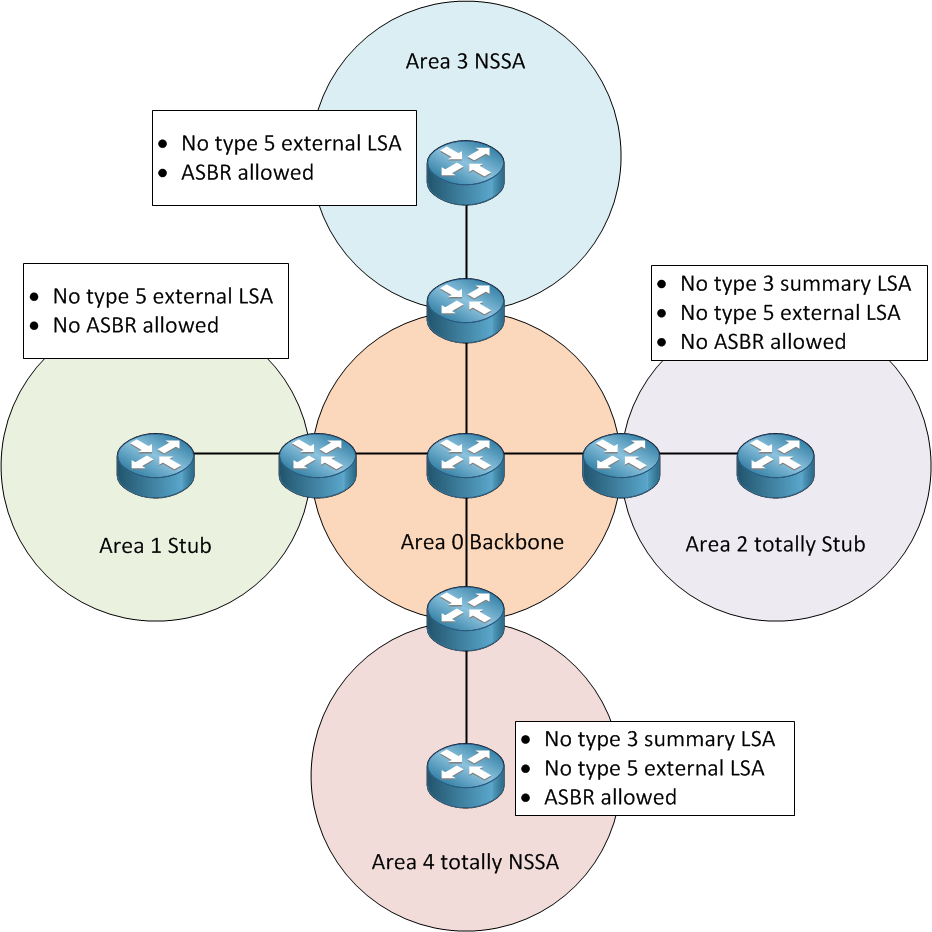
In the OSPF (Open Shortest Path First) protocol, Type 5 and Type 7 LSAs (Link-State Advertisements) are used to address specific routing challenges, particularly related to advertising routes from outside an OSPF autonomous system or within specific OSPF area types. Below is an explanation of the problems they solve:
Type 5 LSA (External LSA)
Problem Solved:
Type 5 LSAs address the need to advertise external routes (routes from outside the OSPF autonomous system, such as routes redistributed from another routing protocol like BGP, RIP, or static routes) to all routers within the OSPF domain, except those in stub areas.
-
Purpose:
- Type 5 LSAs are generated by an Autonomous System Boundary Router (ASBR) to advertise external routes into the OSPF domain.
- They allow OSPF routers to learn about destinations outside the OSPF autonomous system, enabling inter-domain routing.
- These LSAs are flooded throughout the entire OSPF autonomous system (except stub areas), ensuring that all routers (except those in stub or totally stubby areas) have a consistent view of external routes.
-
Key Characteristics:
- Propagated across all OSPF areas (except stub, totally stubby, or not-so-stubby areas unless specific configurations allow it).
- Contains information about the external route, such as the destination, metric, and whether it’s a Type 1 (E1) or Type 2 (E2) external route.
- Helps solve the problem of integrating OSPF with other routing domains by allowing external routing information to be shared.
-
Problem Solved in Context:
Without Type 5 LSAs, OSPF would be limited to intra-domain routing, and there would be no mechanism to share external routing information across the OSPF autonomous system, preventing connectivity to networks outside OSPF’s control.
Type 7 LSA (NSSA External LSA)
Problem Solved:
Type 7 LSAs address the need to advertise external routes within a Not-So-Stubby Area (NSSA) while maintaining the benefits of a stub area (e.g., reduced routing table size by limiting Type 5 LSAs).
-
Purpose:
- Type 7 LSAs are used in NSSAs, which are OSPF areas that allow an ASBR to redistribute external routes but block Type 5 LSAs from entering the area.
- They allow external routes to be advertised within the NSSA without flooding the entire OSPF autonomous system with Type 5 LSAs.
- Type 7 LSAs are generated by an ASBR within the NSSA and are translated into Type 5 LSAs by the Area Border Router (ABR) when the routes need to be advertised to other areas in the OSPF domain.
-
Key Characteristics:
- Type 7 LSAs are only flooded within the NSSA and are not propagated to other areas unless translated.
- They support the P-bit (Propagate bit), which indicates whether the ABR should translate the Type 7 LSA into a Type 5 LSA for advertisement outside the NSSA.
- They allow NSSAs to support external routes while still restricting Type 5 LSAs, reducing the routing table size in the NSSA.
-
Problem Solved in Context:
In a stub area, Type 5 LSAs are not allowed, which prevents the advertisement of external routes. This is problematic if an NSSA contains an ASBR that needs to redistribute external routes. Type 7 LSAs solve this by allowing external routes to be advertised within the NSSA and, if needed, translated into Type 5 LSAs for propagation to other areas, balancing the need for external routing with the efficiency of a stub-like area.
Summary of Problems Solved
- Type 5 LSA: Solves the problem of advertising external routes across the entire OSPF autonomous system, enabling connectivity to networks outside OSPF.
- Type 7 LSA: Solves the problem of advertising external routes within an NSSA while maintaining the benefits of a stub area (no Type 5 LSAs) and allowing controlled propagation of external routes to the rest of the OSPF domain.
Both LSAs ensure OSPF can handle external routing information effectively, with Type 7 LSAs providing a specialized solution for NSSAs.
In the OSPF (Open Shortest Path First) protocol, stub, totally stubby, and not-so-stubby areas (NSSAs) are special area types designed to optimize routing by reducing the size of routing tables and limiting the propagation of certain Link-State Advertisements (LSAs). Each area type addresses specific problems related to routing efficiency, scalability, and resource constraints in OSPF networks. Below is an explanation of the problems each area type solves:
Stub Area
Problem Solved:
Stub areas address the problem of excessive routing table size and processing overhead in areas with limited resources or where external routes are not needed.
-
Purpose:
- A stub area restricts Type 5 LSAs (External LSAs) from being flooded into the area, reducing the number of routes in the routing table.
- Instead of learning individual external routes, routers in a stub area receive a default route (via a Type 3 LSA) from the Area Border Router (ABR) to reach external destinations.
- This reduces memory and CPU usage on routers, especially in environments with many external routes (e.g., redistributed from BGP or other protocols).
-
Key Characteristics:
- Blocks Type 5 LSAs (external routes).
- Allows Type 1, 2, 3, and 4 LSAs (intra-area, inter-area, and ASBR location information).
- Injects a default route (0.0.0.0/0) via a Type 3 LSA for external destinations.
- Cannot contain an Autonomous System Boundary Router (ASBR), as external routes are not advertised.
-
Problem Solved in Context:
In networks with resource-constrained routers or areas where external route details are unnecessary, stub areas reduce the routing table size by replacing potentially thousands of external routes with a single default route, improving scalability and performance.
Totally Stubby Area
Problem Solved:
Totally stubby areas address the problem of further reducing routing table size and processing overhead in areas where neither external routes nor inter-area routes are needed.
-
Purpose:
- A totally stubby area is a more restrictive version of a stub area that blocks both Type 5 LSAs (external routes) and Type 3 LSAs (inter-area routes, also known as Summary LSAs) from entering the area.
- Only a default route (via a Type 3 LSA) is advertised into the area by the ABR to reach both external and inter-area destinations.
- This minimizes the routing table size even further than a stub area, making it ideal for areas with very limited router resources or simple routing requirements.
-
Key Characteristics:
- Blocks Type 3 and Type 5 LSAs (except for the default route advertised as a Type 3 LSA).
- Allows Type 1 and 2 LSAs (intra-area routes).
- Injects a single default route (0.0.0.0/0) via a Type 3 LSA for all non-intra-area destinations.
- Cannot contain an ASBR.
-
Problem Solved in Context:
In scenarios where an area only needs to know about local (intra-area) routes and a default path to reach all other destinations, totally stubby areas eliminate the overhead of maintaining inter-area and external routes, further simplifying routing tables and reducing resource demands.
Not-So-Stubby Area (NSSA)
Problem Solved:
NSSAs address the problem of supporting external routes in a stub-like area while still maintaining the benefits of reduced routing table size and restricted Type 5 LSA flooding.
-
Purpose:
- An NSSA is a hybrid area type that allows an ASBR within the area to redistribute external routes (e.g., from RIP, BGP, or static routes) while still blocking Type 5 LSAs from entering the area.
- External routes are advertised within the NSSA using Type 7 LSAs (NSSA External LSAs), which are flooded only within the NSSA.
- The ABR can translate Type 7 LSAs into Type 5 LSAs to advertise these external routes to other areas in the OSPF domain, if needed.
- Like stub areas, NSSAs inject a default route (via a Type 3 LSA) for external destinations outside the NSSA.
-
Key Characteristics:
- Blocks Type 5 LSAs but allows Type 7 LSAs for external routes within the NSSA.
- Allows Type 1, 2, 3, 4, and 7 LSAs.
- Supports an ASBR within the area, unlike stub or totally stubby areas.
- Injects a default route (0.0.0.0/0) via a Type 3 LSA for external destinations outside the NSSA.
- The ABR may translate Type 7 LSAs into Type 5 LSAs for propagation to other areas.
-
Problem Solved in Context:
Stub and totally stubby areas cannot support ASBRs or external route redistribution, which is problematic if an area needs to redistribute external routes (e.g., from a branch office running RIP). NSSAs solve this by allowing external routes within the area (via Type 7 LSAs) while still restricting Type 5 LSAs, balancing the need for external route support with the efficiency of a stub-like area.
Summary of Problems Solved
- Stub Area: Solves the problem of excessive routing table size and processing overhead by blocking Type 5 LSAs and using a default route for external destinations, ideal for resource-constrained routers.
- Totally Stubby Area: Further reduces routing table size by blocking both Type 3 and Type 5 LSAs, using a single default route for all non-intra-area destinations, ideal for areas with minimal routing needs.
- Not-So-Stubby Area (NSSA): Enables external route redistribution within a stub-like area using Type 7 LSAs, while still blocking Type 5 LSAs and using a default route for external destinations, balancing external route support with routing efficiency.
These area types enhance OSPF’s scalability and flexibility by tailoring the routing information propagated to specific areas based on their requirements and resource constraints.
///////// In the OSPF (Open Shortest Path First) protocol, Link-State Advertisements (LSAs) are used to exchange routing information between routers, and different LSA types serve specific purposes in disseminating this information across various OSPF area types. Additionally, area boundaries play a critical role in controlling the scope of LSA flooding, which impacts routing efficiency and scalability. Below is an explanation of the LSA types, their roles, and how they interact with area boundaries, building on the context of your previous questions about Type 5 and Type 7 LSAs, as well as stub, totally stubby, and not-so-stubby areas (NSSAs).
LSA Types
OSPF uses multiple LSA types to advertise different kinds of routing information. Each LSA type has a specific purpose and scope, and its propagation is influenced by the OSPF area type and boundaries. Here’s a comprehensive overview of the main LSA types:
-
Type 1 LSA (Router LSA):
- Purpose: Advertises the router’s own interfaces (links), their states, and costs within an area.
- Scope: Flooded only within the originating router’s area (intra-area).
- Problem Solved: Provides detailed topology information about a router’s links to other routers or networks within the same area, enabling the construction of the OSPF link-state database.
- Generated by: All OSPF routers.
- Area Boundary Behavior: Type 1 LSAs do not cross area boundaries; they are confined to the area in which they are generated.
-
Type 2 LSA (Network LSA):
- Purpose: Advertises the multi-access network segment (e.g., Ethernet) and the routers attached to it.
- Scope: Flooded only within the originating area (intra-area).
- Problem Solved: Describes the topology of a multi-access network, identifying the Designated Router (DR) and attached routers, which helps in building the shortest path tree.
- Generated by: The Designated Router (DR) for the network.
- Area Boundary Behavior: Like Type 1 LSAs, Type 2 LSAs do not cross area boundaries.
-
Type 3 LSA (Summary LSA):
- Purpose: Advertises inter-area routes (prefixes) from one area to another, summarizing intra-area routes.
- Scope: Flooded across areas by Area Border Routers (ABRs) to all non-stub areas.
- Problem Solved: Enables routers in one area to learn about destinations in other areas without needing the full topology details, reducing routing table size.
- Generated by: ABRs.
- Area Boundary Behavior: Type 3 LSAs are generated by ABRs to advertise routes across area boundaries. They are blocked in totally stubby areas but allowed in standard areas, stub areas, and NSSAs (with a default route often advertised in stub/NSSA).
-
Type 4 LSA (ASBR Summary LSA):
- Purpose: Advertises the location of an Autonomous System Boundary Router (ASBR) to other areas.
- Scope: Flooded across areas by ABRs to all non-stub areas.
- Problem Solved: Informs routers in other areas how to reach the ASBR, which is necessary for routing to external destinations advertised via Type 5 LSAs.
- Generated by: ABRs.
- Area Boundary Behavior: Type 4 LSAs cross area boundaries to advertise the ASBR’s location but are blocked in stub and totally stubby areas (allowed in NSSAs to support Type 7 LSAs).
-
Type 5 LSA (External LSA):
- Purpose: Advertises external routes (redistributed from outside the OSPF autonomous system, e.g., from BGP, RIP, or static routes).
- Scope: Flooded throughout the entire OSPF autonomous system, except to stub, totally stubby, or NSSAs (unless translated from Type 7 in NSSAs).
- Problem Solved: Enables OSPF to integrate with external routing domains by advertising external routes to all routers, ensuring connectivity to non-OSPF networks.
- Generated by: ASBRs.
- Area Boundary Behavior: Type 5 LSAs cross area boundaries freely in standard areas and backbone areas (Area 0) but are blocked in stub, totally stubby, and NSSAs to reduce routing table size.
-
Type 7 LSA (NSSA External LSA):
- Purpose: Advertises external routes within a Not-So-Stubby Area (NSSA) when an ASBR exists in the area.
- Scope: Flooded only within the NSSA.
- Problem Solved: Allows external route redistribution within an NSSA while maintaining the stub-like property of blocking Type 5 LSAs, balancing external route support with routing efficiency.
- Generated by: ASBRs within the NSSA.
- Area Boundary Behavior: Type 7 LSAs are confined to the NSSA. The ABR may translate them into Type 5 LSAs (if the P-bit is set) to advertise the external routes across area boundaries to other parts of the OSPF domain.
-
Other LSA Types (Less Common):
- Type 6 LSA (Group Membership LSA): Used for Multicast OSPF (MOSPF), but not widely supported.
- Type 8 LSA (External Attributes LSA): Used for BGP-OSPF interaction, rarely used.
- Type 9, 10, 11 LSAs (Opaque LSAs): Used for specific applications (e.g., MPLS Traffic Engineering, Graceful Restart). Their scope varies (link-local, area, or autonomous system-wide) based on the type.
- Problem Solved: These provide extensibility for OSPF to support additional features or protocols.
- Area Boundary Behavior: Depends on the opaque LSA type (e.g., Type 10 is area-scoped, Type 11 is AS-scoped).
Area Boundaries and Their Role
OSPF organizes networks into areas to improve scalability and manage the flooding of LSAs. Areas are defined by boundaries, typically enforced by Area Border Routers (ABRs), which control which LSAs can cross into other areas. The behavior of LSAs at area boundaries depends on the area type (standard, backbone, stub, totally stubby, or NSSA). Here’s how area boundaries interact with LSAs and solve specific problems:
-
Standard Area:
- LSA Behavior: Allows Type 1, 2, 3, 4, and 5 LSAs (and Type 7 if an NSSA). All LSAs can cross area boundaries via ABRs to the backbone area (Area 0) and other areas, except as restricted by area type.
- Problem Solved: Provides full routing information for complex networks, ensuring all routers have complete intra-area, inter-area, and external route information.
- Boundary Role: ABRs summarize intra-area routes (Type 1 and 2) into Type 3 LSAs and propagate Type 4 and 5 LSAs to other areas via the backbone.
-
Backbone Area (Area 0):
- LSA Behavior: Handles all LSA types and serves as the transit area for inter-area communication. All non-backbone areas must connect to Area 0 (directly or via virtual links).
- Problem Solved: Ensures a consistent and centralized routing topology by requiring all inter-area traffic to pass through the backbone, preventing routing loops.
- Boundary Role: ABRs in Area 0 flood Type 3, 4, and 5 LSAs to other areas, acting as the central hub for OSPF routing information.
-
Stub Area:
- LSA Behavior: Blocks Type 5 LSAs (external routes) and Type 4 LSAs (ASBR location). Allows Type 1, 2, and 3 LSAs, with a default route (Type 3 LSA) injected by the ABR for external destinations.
- Problem Solved: Reduces routing table size and processing overhead in areas with resource-constrained routers by eliminating external route details.
- Boundary Role: ABRs filter Type 5 and Type 4 LSAs at the area boundary, injecting a default route to maintain connectivity to external networks.
-
Totally Stubby Area:
- LSA Behavior: Blocks Type 3, 4, and 5 LSAs, allowing only Type 1 and 2 LSAs. A default route (Type 3 LSA) is injected by the ABR for all inter-area and external destinations.
- Problem Solved: Further minimizes routing table size by eliminating both external and inter-area routes, ideal for areas with minimal routing needs.
- Boundary Role: ABRs filter Type 3 (except default route), 4, and 5 LSAs at the area boundary, ensuring minimal routing information enters the area.
-
Not-So-Stubby Area (NSSA):
- LSA Behavior: Blocks Type 5 and Type 4 LSAs but allows Type 7 LSAs for external routes within the NSSA. Type 1, 2, 3, and 7 LSAs are permitted, with a default route (Type 3 LSA) for external destinations outside the NSSA.
- Problem Solved: Supports external route redistribution within a stub-like area while maintaining reduced routing table size by blocking Type 5 LSAs.
- Boundary Role: ABRs filter Type 5 and Type 4 LSAs at the area boundary. Type 7 LSAs are confined to the NSSA but can be translated into Type 5 LSAs by the ABR for propagation to other areas.
How LSA Types and Area Boundaries Work Together
- Area boundaries, enforced by ABRs, control the scope of LSA flooding, ensuring that only relevant routing information is propagated. This improves scalability by limiting the amount of routing data each router must process.
- LSA types provide the specific information needed for routing (e.g., intra-area topology, inter-area routes, external routes), and their propagation is tailored to the area type to balance detail with efficiency.
- Problems Solved:
- Scalability: By restricting LSAs (e.g., in stub, totally stubby, or NSSAs), OSPF reduces memory and CPU demands on routers.
- Routing Efficiency: Area boundaries and LSA filtering prevent unnecessary flooding of detailed routing information to areas where it’s not needed.
- Flexibility: Different LSA types (e.g., Type 5 for external routes, Type 7 for NSSA external routes) and area types allow OSPF to support diverse network requirements, from fully detailed routing to minimal default-route-based routing.
Connection to Your Previous Questions
- Type 5 and Type 7 LSAs: As discussed earlier, Type 5 LSAs solve the problem of advertising external routes across the OSPF domain, but they are blocked at stub, totally stubby, and NSSA boundaries. Type 7 LSAs solve the problem of supporting external routes within an NSSA, with ABRs translating them into Type 5 LSAs for propagation across area boundaries.
- Stub, Totally Stubby, and NSSA Areas: These area types leverage area boundaries to filter specific LSAs (Type 5 for stub/NSSA, Type 3 and 5 for totally stubby) to reduce routing table size, while Type 7 LSAs in NSSAs allow external route support without compromising the stub-like efficiency.
Summary
- LSA Types provide the building blocks for OSPF’s routing information, each addressing specific aspects of topology or route advertisement (e.g., Type 1 for intra-area, Type 5 for external, Type 7 for NSSA external).
- Area Boundaries control LSA flooding, with ABRs filtering or translating LSAs based on the area type (standard, backbone, stub, totally stubby, NSSA).
- Problems Solved: Together, LSA types and area boundaries enable OSPF to scale efficiently, reduce resource usage, and support diverse routing scenarios, from detailed enterprise networks to resource-constrained branch offices.
If you’d like a visual representation of how LSAs flow across area boundaries or a deeper dive into a specific LSA type or area configuration, let me know!