OSPF Summarization
Aggregating many specific prefixes into a single summary route at an area boundary. Reduces LSA flood scope, LSDB size, SPF cost, and routing table entries.
Why summarise
Without summarisation, every prefix change inside an area (flap, new subnet, deletion) triggers:
- New/updated LSAs flooded inside the area
- ABR re-advertises the change via Type 3 LSAs to all other areas
- Every router in every area reruns SPF (intra-area) or updates its routing table (inter-area)
With summarisation at the ABR, intra-area churn is hidden from the rest of the OSPF domain. The summary route doesn’t change just because a specific prefix flapped — it changes only when all covered prefixes disappear.
Benefits:
- Smaller LSDBs outside the summarised area
- Fewer SPF recalculations triggered by intra-area events
- Smaller routing tables
- Less control-plane traffic
Two places you summarise
OSPF summarisation only happens at boundaries — never within an area.
| Location | Router role | Summarises | LSA produced |
|---|---|---|---|
| Inter-area boundary | ABR | Intra-area (Type 1/2) routes from the area | Type 3 Summary LSA |
| External boundary | ASBR | External routes redistributed into OSPF | Type 5 External LSA |
See OSPF LSA Types and Areas for the full LSA taxonomy.
Inter-area summarisation (at the ABR)
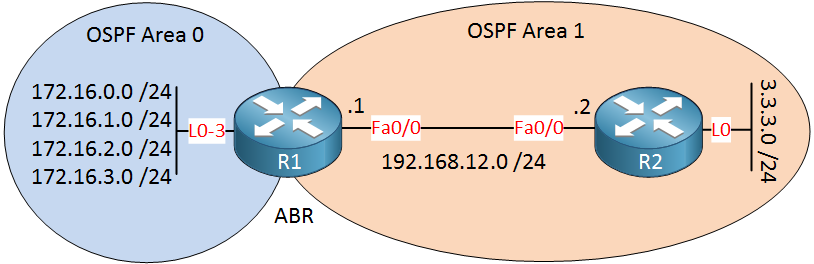
An ABR sits between two or more areas. Normally it injects one Type 3 LSA per intra-area prefix. With summarisation, it replaces them with one LSA for an aggregate prefix.
Example:
- Area 1 contains
10.1.0.0/24,10.1.1.0/24,10.1.2.0/24,10.1.3.0/24 - Without summarisation → 4 Type 3 LSAs into Area 0
- With summarisation (
10.1.0.0/22) → 1 Type 3 LSA into Area 0
Area 0 routers now see 10.1.0.0/22 via the ABR. If 10.1.2.0/24 flaps, Area 0 sees nothing change.
Behaviour when only some prefixes exist
The summary is advertised as long as at least one component route is in the OSPF database. When all components go away, the summary is withdrawn.
Discard routes
When an ABR advertises a summary, it also installs a discard route (a route to the summary pointing at Null0 / “discard”). This prevents routing loops: if a packet arrives for an address inside the summary that doesn’t exist as a specific route, it’s dropped rather than forwarded to a default route and looping back.
External summarisation (at the ASBR)
An ASBR redistributes routes from another protocol (BGP, static, another IGP) into OSPF as Type 5 (or Type 7 in NSSA) External LSAs. Without summarisation, one Type 5 per external prefix. With summarisation, one Type 5 per aggregate.
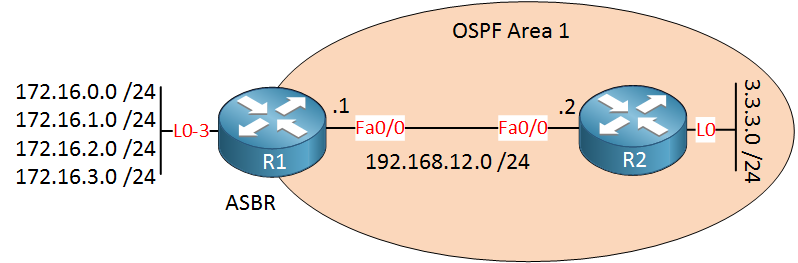
Example:
- ASBR redistributes a BGP feed with 10,000 prefixes in
172.16.0.0/12 - Without summarisation → 10,000 Type 5 LSAs flooded through the OSPF domain
- With summarisation (
172.16.0.0/12) → 1 Type 5 LSA
This is the bigger win numerically; external tables can be huge.
Design rules
- Plan addressing around area boundaries. Summarisation only works if your area’s prefixes are contiguous.
10.1.0.0/24,10.1.1.0/24,10.1.2.0/24summarise cleanly.10.1.0.0/24in area 1 and10.1.1.0/24in area 2 do not. - Summarise at the ABR closest to the source. Don’t summarise downstream of where the prefixes live.
- Never summarise a route you don’t own. Advertising
0.0.0.0/0or a supernet that covers things you can’t deliver is how you black-hole traffic. - Area 0 is rarely summarised. All non-backbone areas connect to it; its routing table is the “ground truth” of the OSPF domain.
Summarisation and stub areas
Stub/totally-stub/NSSA mechanics and summarisation are orthogonal — they solve different problems:
| Concern | Tool |
|---|---|
| Aggregate specific prefixes to one LSA at a boundary | Summarisation |
| Block categories of LSAs from entering an area | Stub area types |
A totally-stubby area gets a single Type 3 default route from its ABR — that’s the extreme case of inter-area summarisation, but it’s a filter, not a summary.
Interaction with routing
- Longest prefix match still wins. If both a summary and a more-specific route are in the routing table, traffic follows the specific one. Summaries typically live only outside the area, so this conflict is unusual.
- Cost of the summary. Defaults to the highest cost of any component route. Some implementations let you set a fixed cost — use sparingly.
Configuration intent (vendor-neutral)
Conceptually, what you configure:
- On the ABR, for inter-area: “From area X, summarise prefixes in network N/mask when advertising to other areas.”
- On the ASBR, for external: “When redistributing into OSPF, summarise redistributed routes matching network N/mask.”
Every vendor’s CLI differs, but the knobs are the same: network, mask, cost (optional), advertise/not-advertise (to filter instead of summarise).